The Authentic Leadership Engine
Leadership isn't about being the smartest person in the room. It's about being the most human — and building systems that let people perform.
Not a flat circle. A sphere.
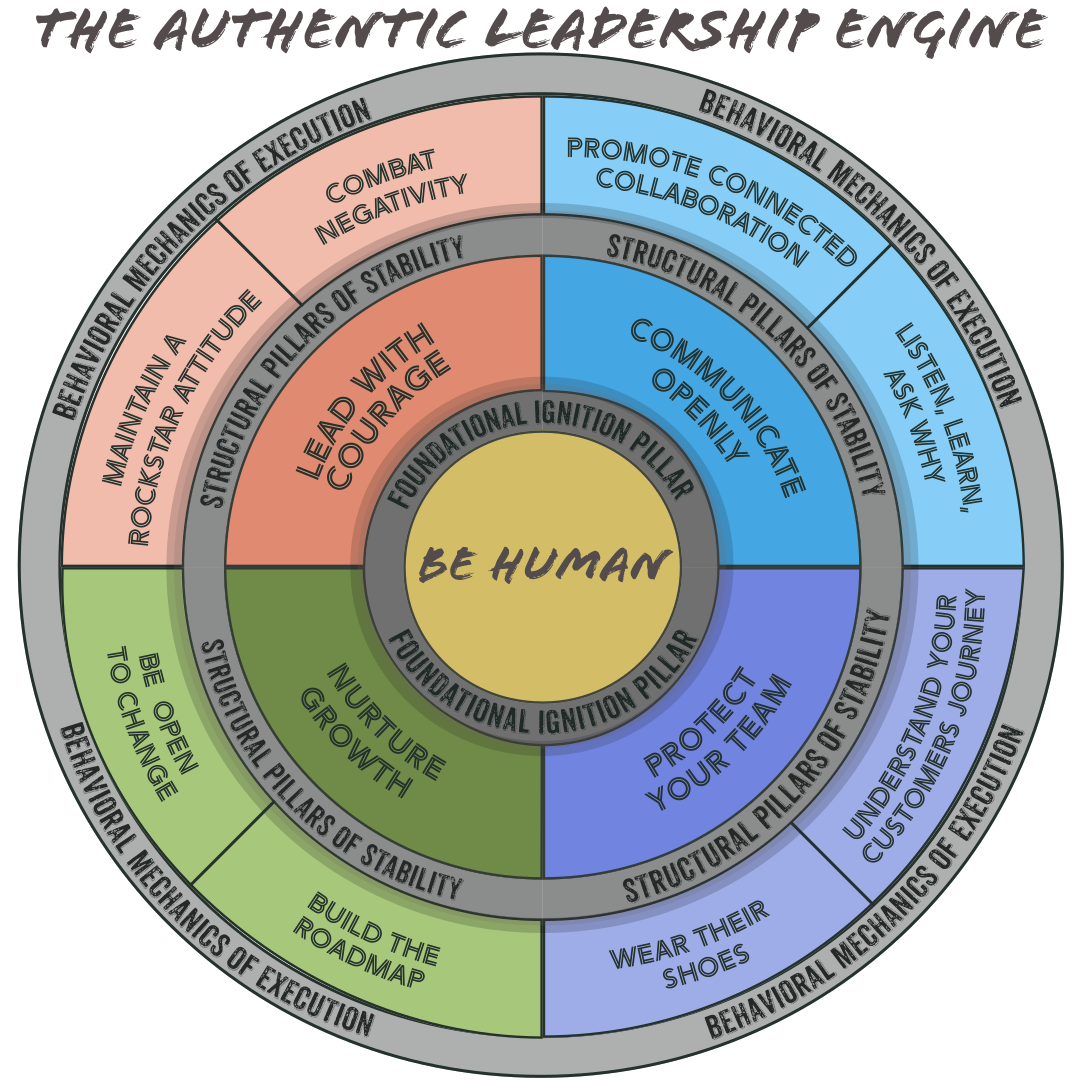
Most leadership frameworks are linear — a staircase of competencies you climb from bottom to top. The Authentic Leadership Engine doesn't work that way. It's spherical. Every layer has a downstream effect on every other layer. Nothing operates in isolation.
At the center is Be Human — the foundation of trust, and trust is the foundation of performance. Surrounding it are four pillars. Each pillar is reinforced by two core behaviors. Remove one behavior and the pillar weakens. Weaken one pillar and the entire sphere contracts.
It's not a theory. It's how I've run every team I've ever led — and it's why those teams have consistently outperformed.
"Humanity is the foundation of trust. Trust is the foundation of performance."
— Monika Sachdeva MeachamBe Human
Being human means understanding that everyone on your team has a life outside of 9 to 5 — and that life affects the work. You don't have to be their best friend. But you do have to acknowledge that you're all in this together, scratching for the same outcome.
When people feel seen by their leader, they stop protecting themselves and start producing. That's not soft leadership. That's the most powerful business strategy you have.
"Humanity is not a weakness. It's the most powerful business strategy you have."
Select a pillar to explore
Each pillar includes two core behaviors and a real story from the field.
Humanity can be perceived as weakness. Courage is the balance.
Humanity at the center can be misread as softness. Leading with courage is the counterbalance — it signals to your team that you will stand up, speak up, and move them forward even when it's uncomfortable. Without courage, the humanity at your core becomes a liability instead of your greatest strength.
"When I stood up a deals desk function from scratch, I was introducing something the organization had never seen before — and telling a room full of sellers that their deals now required review and approval before moving forward. Nobody wants to hear 'no' for the first time. There was resistance, skepticism, and no shortage of people who thought the process would slow everything down. Leading with courage meant absorbing that friction head-on, standing firm on the process, and never flinching. The rockstar attitude kept the team motivated through the pushback. Combating negativity meant showing results fast enough to convert the skeptics — and within months, the same sellers who fought the process were the ones relying on it to get their deals done faster."
Why I built this
Leadership isn't just what your team produces while you're watching.
I've always measured leadership in results. Revenue growth, team output, pipeline velocity — the numbers are real and they matter. But results alone don't tell the whole story.
The moment that reframed everything didn't happen in a boardroom. After one of the hardest weeks of my life, people showed up for me — colleagues from teams I hadn't led in years, from companies long behind me. People who drove hours and rearranged their days without being asked. None of them had anything to gain. They came because of a relationship, not a transaction.
"A leader is something more than results. It's seeing the people you grow, and the people who come back for you when you need them."
That's when I sat down and asked myself: what keeps showing up, across every team, every company, every industry? And how do I put it on paper? The Authentic Leadership Engine is my answer — drawn from 20+ years of patterns I kept living. Not theories. Practice.
The framework didn't come from a whiteboard. It came from moments like these.
Nurture growth in practice
An analyst others had written off — someone I hired because I saw passion in him before anyone else did — grew under this framework from analyst to director, leading a team of 15. Passion is something you can't manufacture. When you see it, you build around it. That's what I did.
Leading without authority
The move that brought me to Ringer wasn't planned — it was a choice to protect someone on my team who couldn't afford to lose what I could. I negotiated my own exit, structured an arrangement that worked for everyone, and stepped into something I'd been architecting alongside the company's founder — who happened to be my husband. Choosing people over convenience is the thread that runs through everything I build.
When people feel seen, they stop clocking in and start caring.
They stay longer, solve problems you didn't know existed, and carry the culture forward without being asked. The business case for human-centered leadership isn't soft — it's the highest-performing strategy I've seen, across every team, every company, every market condition. Here's the framework behind it.
"I didn't build teams by being the smartest person in the room. I built them by making sure everyone else had room to become that person."
— Monika Sachdeva Meacham